Friday, September 23, 2011

Good and Bad fBO


I've often mentioned that trading with-trend in a trend is the easiest way to trade and fBO are some of the hardest trades to take. The reason is very simple. Market inertia dictates that when in a trend, the market is likely to continue in the trend and the with-trend entry is a high probability setup. A fBO on the other hand could turn into a BP or fail on the first or second attempts and work only on the third attempt (as a mini-W).

This is why unless the range is large, you shouldn't even bother taking fBO trades. With that caveat, we can still attempt to deduce the best and worst fBO setups.

The first fBO setup is b2, the failure of the breakout of the large bar b1, which acts as a small TR. Since the entry would be in the lower half of the range, it is likely to fail, esp. since its a first entry. If the entry was very close to the high of b1, this would be worth the risk reward only because the bar is large. If the bar were 4 points or smaller, its best to ignore the fBO of b1.

The second fBO is b6, an attempt to reverse the close of prior day and three pushes up (b2,4,6). This is a higher probability trade and can be labeled OR.

The next possible fBO/BP was b16, which was a strong BO and did not give a decent BP signal bar. At this point, we have a higher high and a higher low and we are in a possible bull trend and should not look to trade fBOs. Rather we should look for 2L PB to ema or TL and take with-trend trades or watch for a trend break. This means we would ignore b21 and even b24 if it was well-formed.

The one-legged move to and close below ema at b29 possibly broke the trend, so we should again switch to looking for fBO and BP. The three push to b45 is an OK setup, but normally, I avoid taking mid-range entries when the market is not in a trend. If we had been in a trend or the move to b23 was a strong trend, I would consider buying b47 as a possible G2.

The fBO at b55 is the most desirable kind of fBO. The bar that broke above the HOD turned into a reversal bar with out overlaps of any other bar. (A doji is an acceptable fBO signal at extremes of the day). A reversal bar or inside bar after the BO bar would also be excellent signals.

To summarize, good fBOs are three pushes beyond the trading range or failures immediately after the breakout when you are certain you are not in a trend.

Thursday, September 22, 2011

Risk of pullbacks and failures


Traders are often surprised at how violently their stops are sometimes taken out such as the short below b14 or the long above b15. Signal bar selection is very important if you wish to use stop entries to enter on the breakout of signal bars. Almost all failures for stop entries have a few common characteristics and mastering them will reduce your error rate.

1. Overlaps: Overlaps, especially large bar overlaps are the easiest risk to recognize and evaluate. In general large bars are poor signal bars regardless of overlap. Any overlap practically guarantees the trading range attribute of the signal bars and you should wait for a small bar at one end of the overlap (b16, b26) and take the fBO of the overlap. Overlaps of small bars such as b47-51 are usually ok to take a second attempt with-trend. These should never be taken in a trading range (expecting a breakout for example) and never the first attempt.

2. Dojis before reversal bars: Dojis represent a trading range and a reversal bar after the doji does not invalidate this fact (b21-22). A second attempt, especially after trapping traders in both directions (b35) may be an OK entry to take even with dojis.

3. First attempts: Its clear from the charts that first attempts (b22, b33, b60) are highly likely to fail compared to second attempts. First attempts should be reserved for very clear and very specific cases such as 1Rev (b3), W reversals (b72) and 1PB or at the very least only for excellent signal bars.

4. Poor signal bars: Poor signal bars (b11, b60) almost certainly will give a pullback simply because some traders will fade its breakout. This is why a second attempt is recommended if the signal bar is the wrong color, has a long entry-side tail or is a doji. Even if the first attempt succeeds, there is usually a pullback before the market moves too far from the entry off a poor bar.

If you consider bars that had minimal pullback, i.e., went a large distance before a pullback and hence are swing candidates(b7,64,72), they usually are well-formed bars with a strong close or are second attempts (b16, 35). Restricting your entries only to such bars should greatly reduce your error rate, which is a precondition to increasing your trade size.

Tuesday, September 20, 2011

Early and late trend breaks


Early trend breaks are easier to spot correctly and the probability of them giving a sizeable trend move is high. Late trends are rather hard to predict and they will often go only a small distance or fail. This is why 1PB (b9) is a very vital setup to master. Catching the major portion of the early trend move allows you to relax and ignore the low probability setups during mid-day and optionally jump into any late trend break.

Late trend breaks are often very hard to spot and you will encounter may false starts such as the possible W at b40 or the second W at b55. The DP b22,46,49 was probably a decent signal, but the spike on b56 took out any swing stops.

The clearest and simplest entry for any trend break is a BP (b66). Even though it looks like the bottom of the range, a BP often is worth the risk given prior signals such as the failed W and the DP.

However, reading 1PB and OR are vastly easier than reading a breakout from an extended consolidation. If you cannot trade 1PB consistently, its unlikely you will be able to predict the BO from an extended TR consistently.

Monday, September 19, 2011

Overlapping bars produce poor signals


Somewhere bear b11 was a fBO or 1Rev. Unfortunately, the bars were overlapping and full of tails, so my indicator could not catch them. On such days, I look to see if the 3m chart has clearer bars. Today it did:


The risk of trading 3m chart is that they are unreliable after the first hour. For example, 3m b68, b72 and b105 entries failed even though there were reasonable bars. However, in the first hour and only if the 5m chart has overlap overflow, the 3m can be used.

Often setups that are unclear on the 5m are clarified on the 3m. For example the LOD reversal was a inside doji bar inside a bear bar on the 5m, but an ii FF on the 3rd push on the 3m. This may enable a great entry on an otherwise poor day.

The psychological risk of trading time-frames smaller than 5m is that you get addicted to the small risk and good prices and trade them beyond the first hour. This is usually dangerous, esp. during lunch hour where even the 5m chart is dangerous.

Friday, September 16, 2011

Price Action Indicator


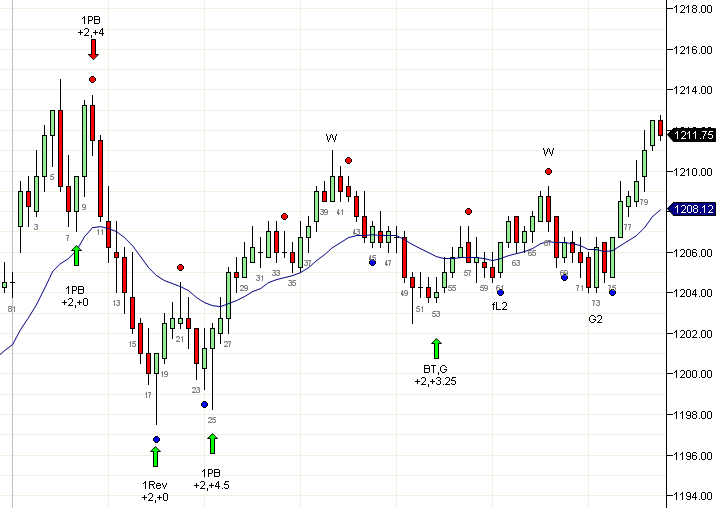
As many of you have guessed from the dots on the chart, I've been working on a Price Action Indicator for NinjaTrader. Currently, it only highlights reasonable signal bars as described in Al Brooks book and nothing else.

To mechanically trade the indicator, a scalp and a swing portion can be entered with a 6t stop. At +2 points the scalp portion exits with a profit and the stop moves to breakeven. Ideally, the scalp portion is twice the swing portion to get the best results. The swing portion should be exited at a fixed profit such as +4 or on a second attempt to reverse a trend if the entry is with trend, i.e, long at HL (b25) or short from LH (b10). If its a counter-trend entry, the first sell signal should cause any swing portion to be exited (entry above b18 or below b41)

On a day with reasonable range such as today this should profit from most trades. For example, today the only losing trade was the short below b57. The short below b34 and the longs above b45 and b69 were first attempts (L1/H1) and would not be traded. One option is to mark the L1/H1 in a different color since eliminating them is not an option since that would eliminate any signals in a hard trend.

A 2 contract scalp + 1 contract swing would have made +40 on the wins and -3 on the losses. But today was possibly an excellent day for the indicator and not all days are so generous. To collect more data, I would need to automatically trade it and run it over a couple of years worth of data. I expect poor performance on tight trading range days since two point scalps are probably hard on a 5 point day. Large range days would probably be indeterminate, causing stop outs before the profit target is reached but a single swing may compensate for many losses.

Thursday, September 15, 2011

Price action Basics III - 1st Reversal or Opening Reversal


When the day opens, one option is to treat the first bar as a trading range and watch for fBO and BP of b1. If the BO or  fBO looks compelling, it may lead to a trend and you should take a strong signal bar such as b8 or b19. The larger the distance to the other extreme of the day, the higher the chances of a trend developing. Therefore, its perfectly fine to ignore something like b3 and wait for a break above the HOD (b1 at this point) and wait for a failure or BP.

When the move is possibly a trend move (b8-b19), no matter how small, its reversal is a 1Rev and is likely to lead to the primary move of the day.

Since 1Revs can fail, conservative traders can take a 1PB if the fBO or BO succeeds. In other words buy only the HL after a bullish reversal and a LH after a bearish reversal. Today's 1PB would be b24, which is not well formed, so its acceptable to skip it and wait for the next setup. You should only take with-primary trend setups until the other extreme of the day is taken out.

This strategy works for almost any day except tight trading ranges with tiny bars. On those days, very few things work and price action entries have a high failure rate, so its best to skip trading if the range of the first hour or two is very small, especially if there was no gap on open.

Wednesday, September 14, 2011

Price Action Basics II - Reversals and pullbacks in trends


When the market is in a trend move, it will continue to be in the trend until there is a very strong overshoot or a very clear trendline break. When in a trend, every counter-trend signal is probably a trap and you should ignore it and wait for its failure. Even with the very clear and obvious W at b53 after an obvious buy climax, the risk of failure is high.

An obnoxious overshoot such as b11 or an obvious trendline break such as b74-79 and a successful test of the extreme is necessary before any counter-trend trades are attempted. A failed L2 (b13,15) after a bullish reversal (b11) is a strong confirmation of the reversal and the next buy signal is usually good for a swing.

The W entry is the only counter-trend trade you ever need to take since it usually gives a confirmation and a with trend W1P right after. Every reversal signal in a trend is probably a pullback and nothing more until counter strength is demonstrated. You should look for with-trend signals near the ema or trend line. Ignore signals far away from them (b30,46,52) since they imply possibly another leg in the pullback.